

When comparing Carbon Fiber and Kevlar®, the first thing we need to clarify is that Kevlar® is actually a brand name, not a material category. It’s DuPont’s trademark for a specific type of aramid fiber.
So what are we really comparing? Carbon fiber vs aramid fibers. And that’s where the classic question shows up.
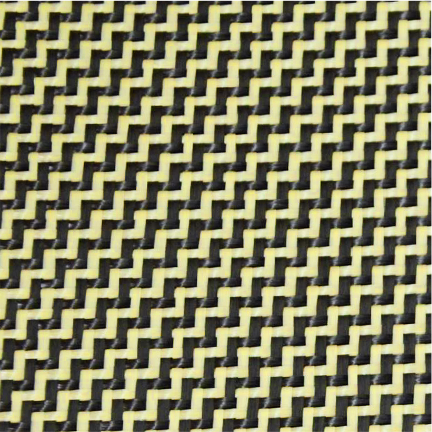
Hybrid fabric with carbon and aramid fibers
Which one is better? Carbon fiber or aramid?
The honest answer: neither, unless you know what you want it for. But there’s a general rule of thumb:
- Aramid fibers (like Kevlar®) excel in impact resistance, toughness, and abrasion resistance.
- Carbon fiber dominates in stiffness, strength-to-weight ratio, and compressive performance.
The real difference isn’t raw strength, it’s how each material behaves when things go wrong. Let’s see how they compare.
Carbon fiber typically stretches only about 1.5% before failure, while Aramids can elongate up to 4%, allowing them to absorb energy instead of cracking.
Carbon Fiber: The King of Stiffness
Carbon fiber is made from highly aligned crystalline carbon filaments as we explained in an article about What is exactly Carbon Fiber. This structure gives it extraordinary rigidity and one defining characteristic. There are multiple types of carbon fiber and this varies depending on the exact specification, but as a general rule we can say that carbon fiber really doesn’t like to bend.
Its stiffness (Young’s modulus up to hundreds of GPa) allows engineers to create ultra-light structures that remain dimensionally stable under heavy loads.
Why engineers love carbon fiber
- Exceptional strength-to-weight ratio
- Extremely high stiffness
- High compressive strength
- Excellent thermal performance
- Strong UV resistance compared to other fibers
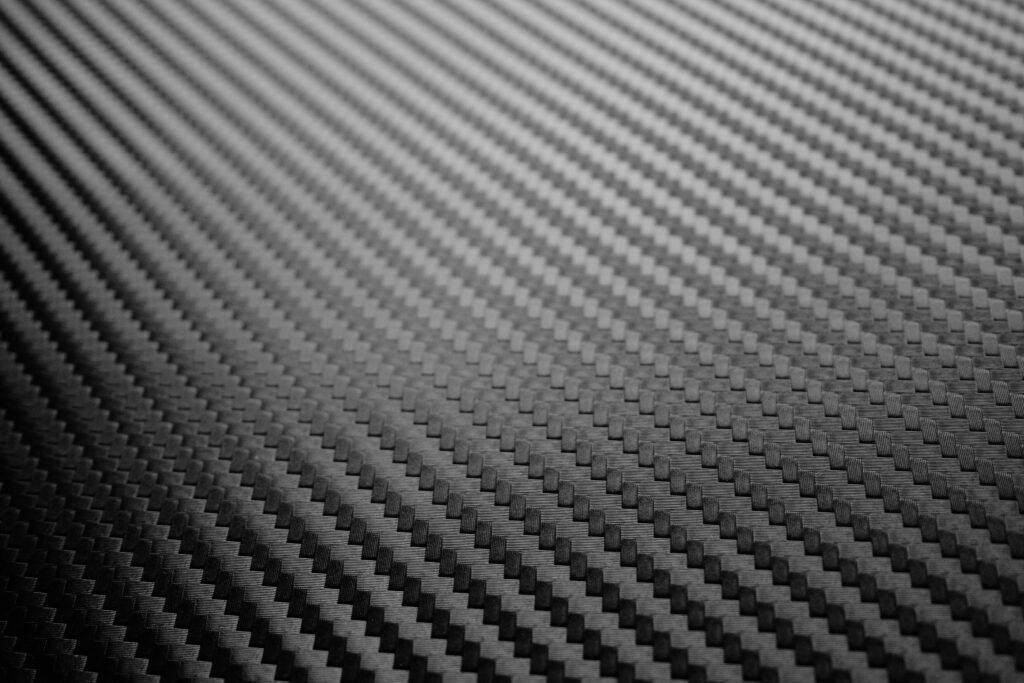
Carbon fiber pattern
That’s exactly why carbon fiber shows up everywhere in high-performance engineering. These applications are some of the most carbon fiber intensive:
- Aircraft structures
- Formula 1 chassis
- High-performance cars
- Drone frames
- High-end bicycles
- Structural panels and robotic arms
When rigidity and precision are needed, carbon fiber wins.
Kevlar®: The King of Toughness
Kevlar was engineered with a completely different philosophy: survive impacts instead of resisting deformation. Its molecular structure allows to absorb more energy, wich makes it shine when experiencing impacts.
What makes Kevlar® and aramids so special?
- Exceptional impact resistance
- Outstanding abrasion resistance
- High toughness and energy absorption
- Slightly lower density than carbon fiber
- Strong resistance to many chemicals and fuels
That’s why aramids are so popular for ballistic protection and impact-heavy environments.
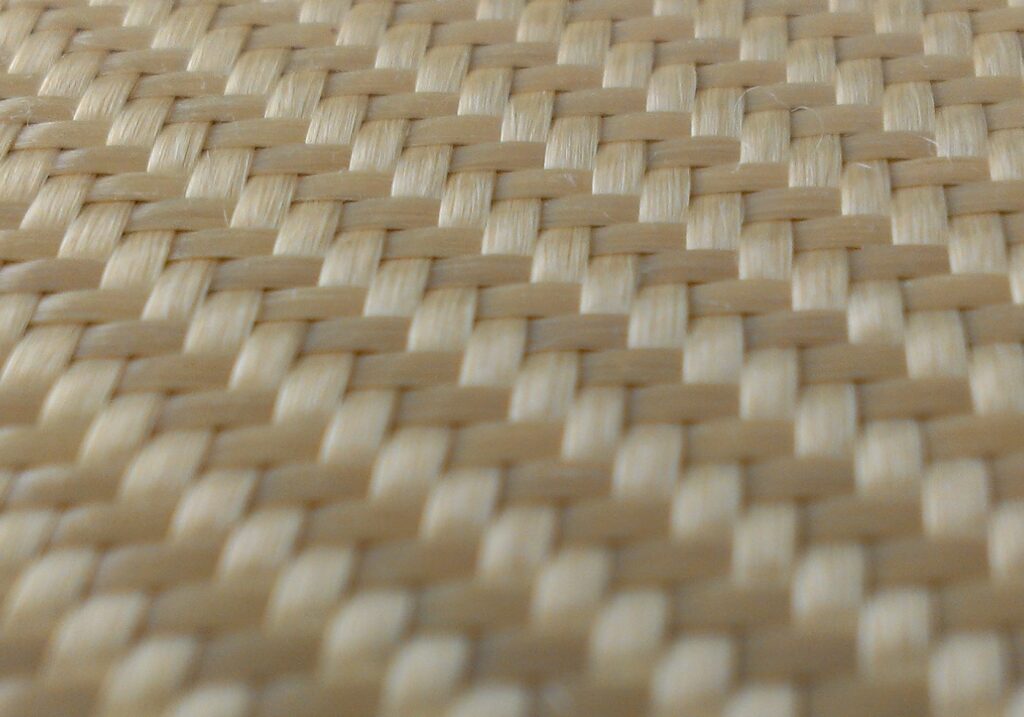
Aramid fabric
The trade-offs of Kevlar®
Kevlar struggles where carbon fiber excels:
- Poor compressive strength (fibers can buckle)
- Lower stiffness
- Sensitive to UV exposure without protection
- Difficult machining and cutting due to high abrasion resistance
Why Carbon Fiber and Kevlar Behave So Differently
The difference comes down to energy management.
Carbon fiber:
- High modulus
- Minimal elongation
- Stores elastic energy
- Tends to fail more suddenly than Kevlar
Kevlar:
- Lower modulus
- Higher elongation
- Dissipates impact energy
- Tends to fail more progressively than carbon fiber
One resists movement. The other absorbs it. Kevlar ® also shows better abrasion resistance, while carbon fiber maintains superior dimensional stability under load.
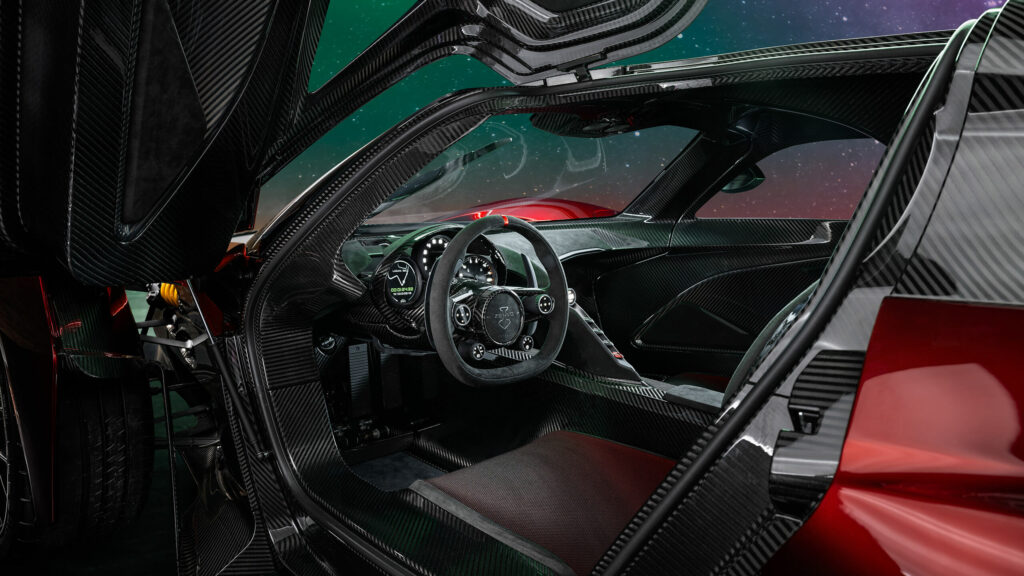
Carbon fiber plays a key role in hypercar performance and is widely used in many other high-performance sectors.
Carbon Fiber vs Kevlar: Quick Comparison
| Property | Carbon Fiber | Kevlar® (Aramid) | Best Choice |
| Stiffness | Extremely high | Moderate | Carbon Fiber |
| Tensile Strength | Very high (3.5–6 GPa) | Very high (~3–3.6 GPa) | Carbon Fiber |
| Impact Resistance | Low (brittle) | Extremely high | Kevlar |
| Compressive Strength | High | Low | Carbon Fiber |
| Density | ~1.6 g/cm³ | ~1.44 g/cm³ | Kevlar |
| Abrasion Resistance | Moderate | Excellent | Kevlar |
| UV Resistance | Very good | Poor (needs protection) | Carbon Fiber |
| Chemical Resistance | Stable | Excellent vs many solvents | Kevlar |
When to choose carbon fiber over Kevlar®?
Carbon fiber is the correct choice when a rigid lightweight structure is needed. For example, Drone arms, aerospace panels, structural components, etc.
When is aramid better than carbon fiber?
As a general rule, in case impact or abrasion resistance are desirable, aramids tend to provide a better solution than carbon fiber, like for kayak skid plates, protective gear, armor layers, etc.
Hybrid Carbon/Kevlar composites: The best of both materials.
Although some precautions must be taken when using them, hybrid laminates combining both fibers are very common because they take advantage of the strengths of each material.
- Kevlar® inner layers to absorb impacts and prevent catastrophic failure
- Carbon fiber outer layers to provide stiffness and UV protection
- Hybrid fabrics with aramid and carbon fibers
This hybrid approach balances rigidity and survivability, improving it’s overall performance.
TL;DR
Carbon fiber and Kevlar® aren’t better or worse than each other — they’re designed for different jobs.
- Carbon fiber shines when stiffness, dimensional stability, and high strength-to-weight ratio are required.
- Kevlar® (aramid fibers) excels in impact resistance, toughness, and abrasion resistance. It absorbs energy instead of cracking, but lacks stiffness and compressive strength.
Engineering is always more nuanced, but as a quick rule of thumb for rigidity and precision, carbon fiber wins. For impact protection and durability, Kevlar is normally better. Sometimes it is worth combining both using hybrid carbon/Kevlar® composites.
In composites engineering, the real question isn’t which material is stronger — it’s how you want the structure to behave.