

Quality control in composites isn’t just important — it’s non-negotiable. Unlike metals, where properties come “pre-installed,” composites are created as you build the structure. That means every temperature shift, every ply, every gram of resin can make the difference between a perfect part and a very expensive paperweight. Because composite manufacturing happens in multiple steps, quality control has to stay awake through all of them.
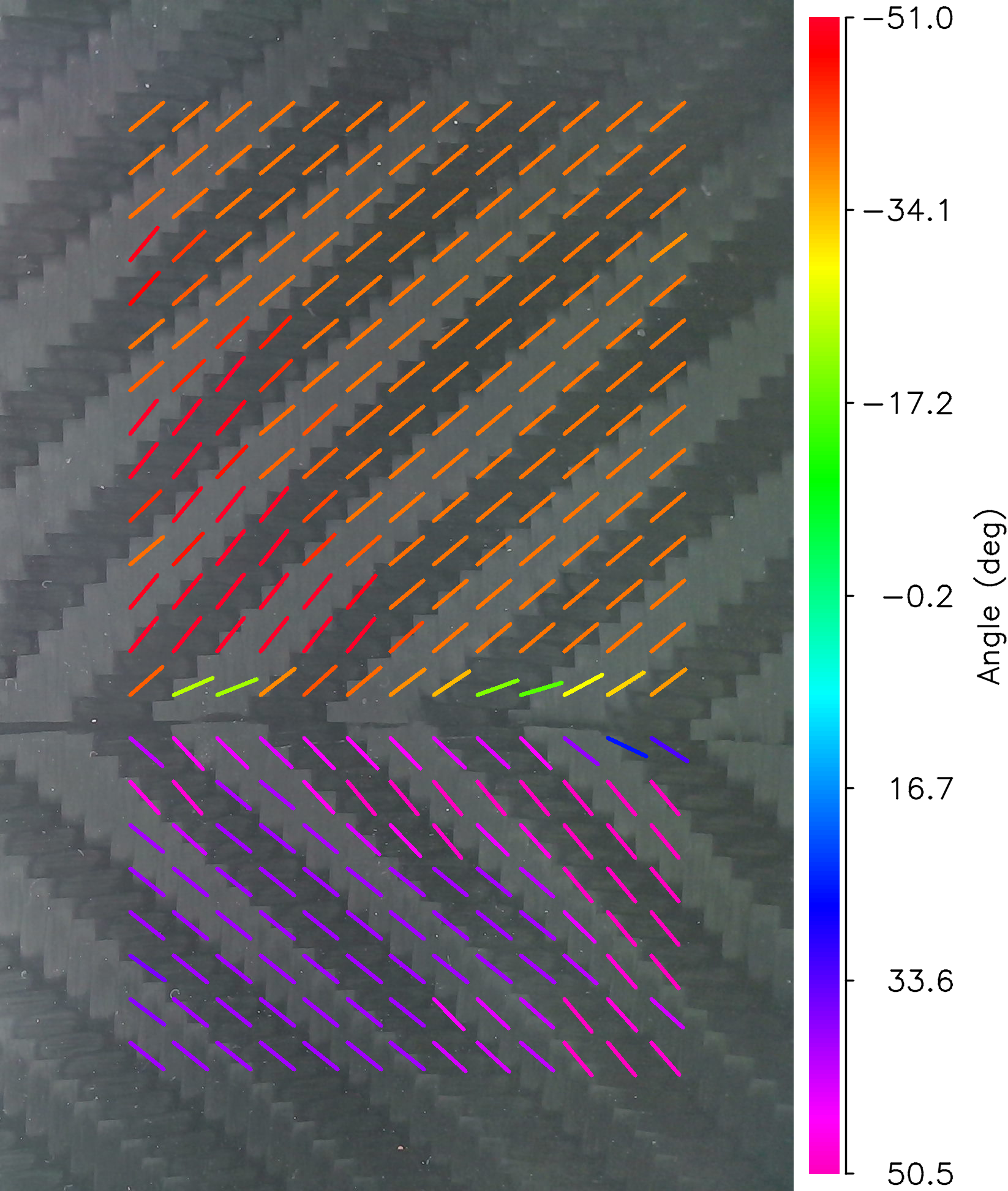
Computer Vision Assisted Quality Control tools automatically generate Fiber-orientation maps, showing real ply angles across the carbon-fiber laminate and highlighting deviations that could affect structural performance and visual quality.
Inspections Before Manufacturing
Quality starts way before anyone touches a mold. Fibers and resins go through chemical and mechanical checks to make sure every batch behaves the way it should. Prepregs get their own VIP treatment: areal weight, resin distribution, tack, and general condition are inspected to confirm they’ll process smoothly and won’t surprise anyone halfway through a layup.
Only after materials pass documentation reviews and supplier audits — full traceability, stable processes, no mysteries — are they allowed anywhere near production. This is how you avoid building defects into the part before the part even exists.
Inspections During Manufacturing
Once manufacturing kicks off, the mission is simple: every ply exactly where it’s supposed to be, every process parameter exactly as specified. Cure temperatures, ramp rates, pressure, dwell times — composites don’t forgive improvisation.
Fiber orientation, ply sequence, handling… everything gets monitored to avoid wrinkles, gaps, overlaps, and other uninvited guests. Vacuum integrity and consolidation are checked constantly to keep porosity and trapped air out of the picture. Real-time inspection is your best friend here — catch issues early, long before they become laminate-level drama.
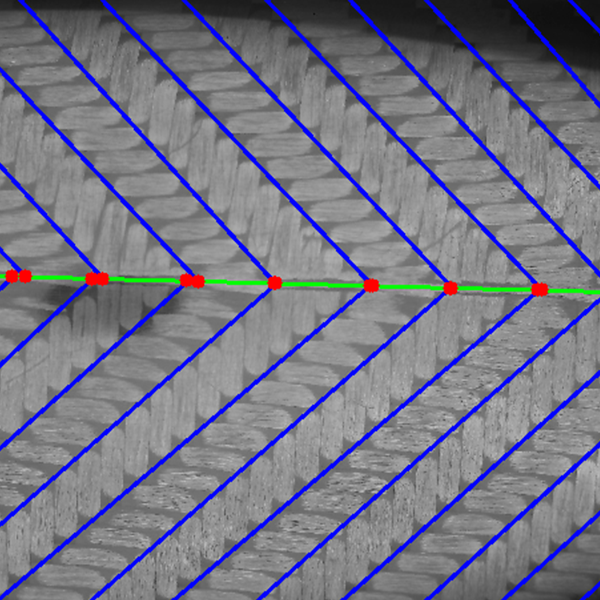
Computer-vision tools automatically detect upward or downward trends in key variables—often long before they go out of tolerance—allowing corrective adjustments to be applied in time.
This is where automated computer vision really shines. Deviations humans would never catch? Detected instantly. That’s why at Managing Composites we built ESEN·EYE: it spots early-stage deviations, and keeps your process comfortably inside tolerance instead of flirting with disaster.
Inspections After Manufacturing
After demolding, the inspection game isn’t over — it just gets more forensic. Among other Non Destructive Tests (NDT) available, Computer-vision systems like ESEN·EYE capture high-resolution details to spot wrinkles, dry areas, pinholes, FOD or any cosmetic defects that think they can hide.
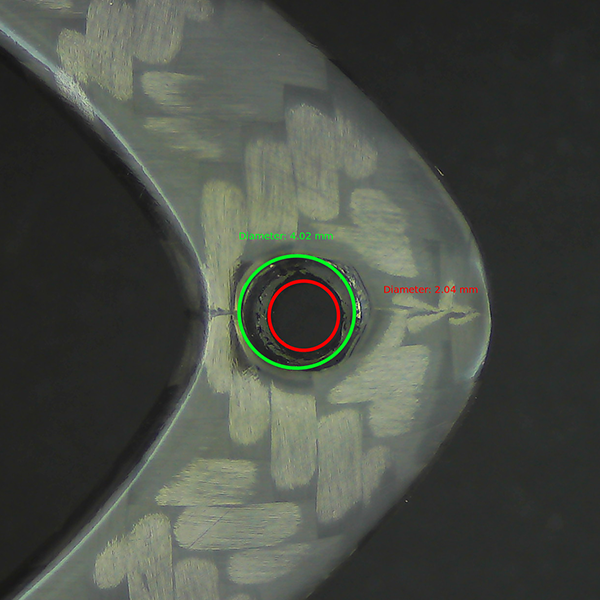
This image shows the result of an automatic diameter analysis on a machined hole in a carbon-fiber component. The system overlays precise inner and outer diameter measurements, detects deviations from nominal values, and highlights tolerance issues instantly.
Fiber alignment and orientation (the silent heroes of performance and aesthetics) get checked with precision. Inserts, machining features, geometry, symmetry — all the usual suspects — are validated against the exact spec of your production line. And because computer vision doesn’t get tired, moody, or biased, every measurement stays fully objective.
Other Benefits of Computer-Vision-Assisted Quality Control
Scanning 100% of every part means nothing slips through. Automatic quality reports give you a crystal-clear snapshot of each component, plus full traceability and a historical production archive — ideal for audits, troubleshooting, or proving to someone that yes, the part was perfect when it left your shop.
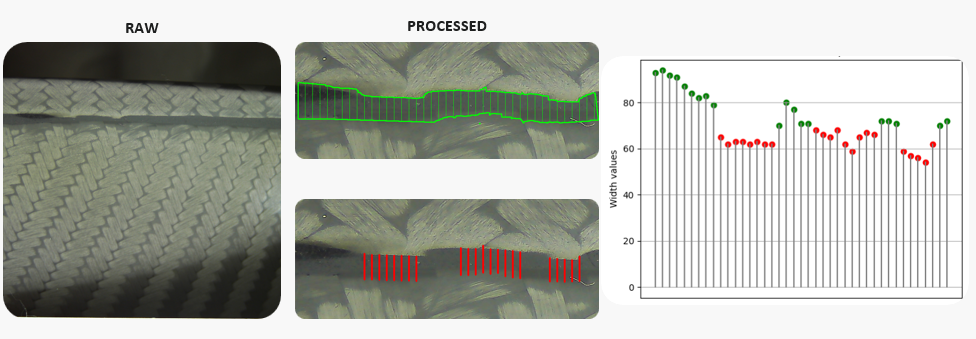
Collecting statistical data from every part and every production run allows manufacturers to keep a full record of each component, build statistical databases, and apply data-analysis tools to continuously improve the manufacturing process
TL;DR
Quality control in composites matters because you’re literally manufacturing the material as you build the part.
Before production: fibers, resins, and prepregs should be checked, so no defect sneaks in disguised as a “raw material issue.”
During production: monitor layup, fiber orientation, vacuum, and cure — with systems like ESEN·EYE catching early-stage deviations your eyes will never see.
After production: high-resolution computer vision verifies surface quality, fiber alignment, geometry, inserts… everything — delivering reliable specs and full traceability.