

Carbon fiber and titanium are two of the most premium materials out there for high-performance parts. Even though both have outstanding mechanical properties, they’re pretty different in key ways—so let’s break them down and see when it makes more sense to go with one over the other.
Like we’ve done in previous comparisons (carbon fiber vs. steel or Carbon Fiber vs Aluminum), keep in mind there are tons of titanium alloys and different types of carbon fiber and resins. So we’re sticking to the most common setups: standard carbon fiber with epoxy resin, and Ti-6Al-4V (Grade 5) titanium.
Comparison between carbon fiber and titanium
A lot of their properties aren’t directly comparable, but here are some of the most relevant ones:
| Characteristic | Carbon Fiber | Titanium |
| Modulus of elasticity | 240 GPa | 115 GPa |
| Density | 1.8 g/cm³ | 4.4 g/cm³ |
| Thermal expansion | Typically very low | Medium |
| Tensile strength | 3,000 MPa | 1,100 MPa |
| Ductility | 1.5% | 10% |
When is carbon fiber clearly better than titanium?
Titanium is probably the metal that comes closest to competing with carbon fiber in pure mechanical performance, but it’s also one of the most expensive metals, which can make it less appealing for some projects.
Generally speaking, carbon fiber has a better strength-to-weight ratio. So if weight matters a lot and you need high stiffness, carbon fiber usually comes out ahead. It’s also anisotropic, meaning you can tailor the material to handle loads in specific directions, great for optimized designs.

Ultralight ribs of a wing made of carbon fiber. Credit: DLR German Aerospace Center
Another big advantage: carbon fiber has a much lower thermal expansion coefficient. That makes it ideal for parts that need to keep their shape and dimensions even when temperatures change.
When is titanium clearly better than carbon fiber?
Titanium is less brittle than carbon fiber, so it handles impacts much better. It’s also isotropic, meaning its mechanical properties are the same in every direction, unlike carbon fiber.
Titanium really shines in high-temperature environments. While there are special resins that improve carbon fiber’s heat resistance, it’s generally not a great choice above 200–250°C or for direct contact with flames or exhaust gases over long periods. Titanium, on the other hand, can handle continuous temperatures of 500–600°C without degrading.
Where do they compete?
Turbine blades
Carbon fiber and titanium often go head-to-head in high-performance industries like aerospace. For example, aircraft turbine blades used to be made from titanium, but in 1995, General Electric switched to carbon fiber for the GE90 engine (the largest engine used on commercial aircraft). This made the blades lighter, though they added titanium to the leading edge to better handle impacts from birds or debris.

Fan blades of the GE90, made of carbon fiber with a titanium leading edge. Photo credit: Hermann Luyken.
Even today, both materials are still used for turbine blades depending on the specific engine design.
Health sector
Titanium has long been a go-to in medicine thanks to its excellent biocompatibility, corrosion resistance, and strength-to-weight ratio. It’s used for implants, prosthetics, plates, screws—you name it. Carbon fiber, meanwhile, is widely used in orthopedic prosthetics.
More recently, carbon fiber–reinforced PEEK (CFR-PEEK) nails have been gaining traction. These advanced, radiolucent implants are especially useful in orthopedic oncology for treating pathological fractures in long bones. One of their biggest advantages is that they allow clear imaging to monitor tumor progression or healing—unlike metal implants, which can interfere with X-rays and MRI scans. They’re also ideal for patients undergoing radiation therapy since they don’t create backscatter.
Exhaust systems
Exhaust systems are a great place to shave off weight on motorcycles. That’s why high-performance exhausts are often made from titanium, carbon fiber, or a mix of both.
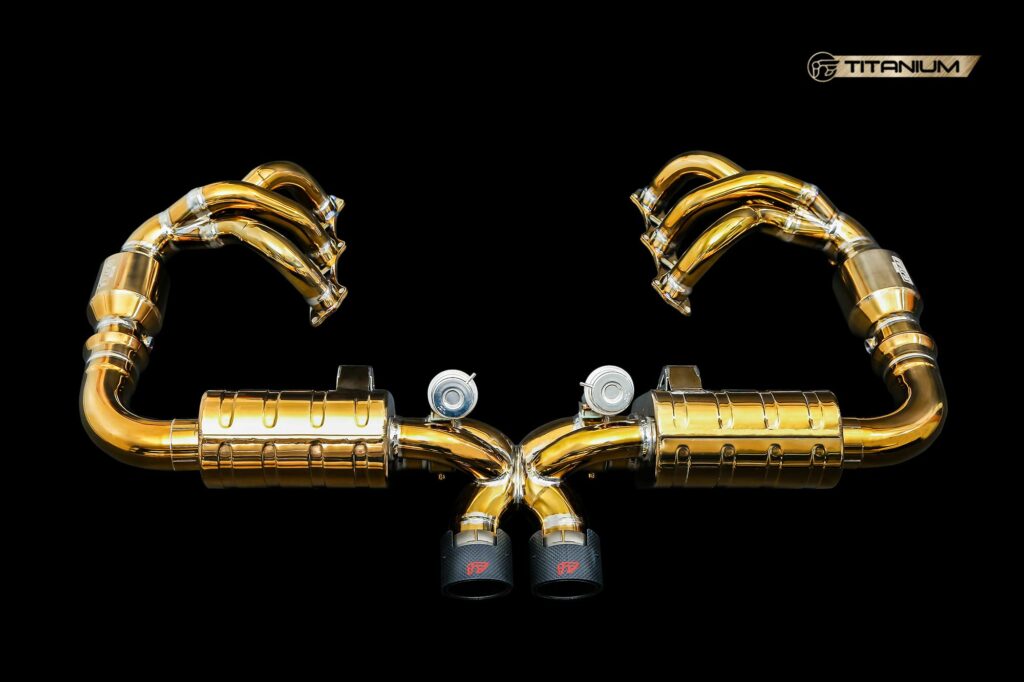
Titanium exhaust system for Porsche 991 GT· RS with carbon fiber ends. Credit: Ian.ou.ipe
Carbon fiber versions are lighter, but they usually still use stainless steel or titanium internals where the hot gases flow. They work great for street bikes, even sporty ones. But for track use—where temperatures stay extremely high for long periods—titanium tends to be the better option.
Bicycles
Both titanium and carbon fiber bikes compete in the same space.
Carbon fiber is usually the go-to if you want the lightest possible bike. Titanium, on the other hand, is perfect if you want something lightweight but tough. Carbon fiber bikes can be more fragile when it comes to crashes or impacts, while titanium bikes can take a lot more abuse without issues.
When does it make sense to combine carbon fiber and titanium?
We already saw the turbine blade example: carbon fiber for lightweight structure, titanium on the leading edge for impact resistance. That’s a perfect example of using each material where it performs best.
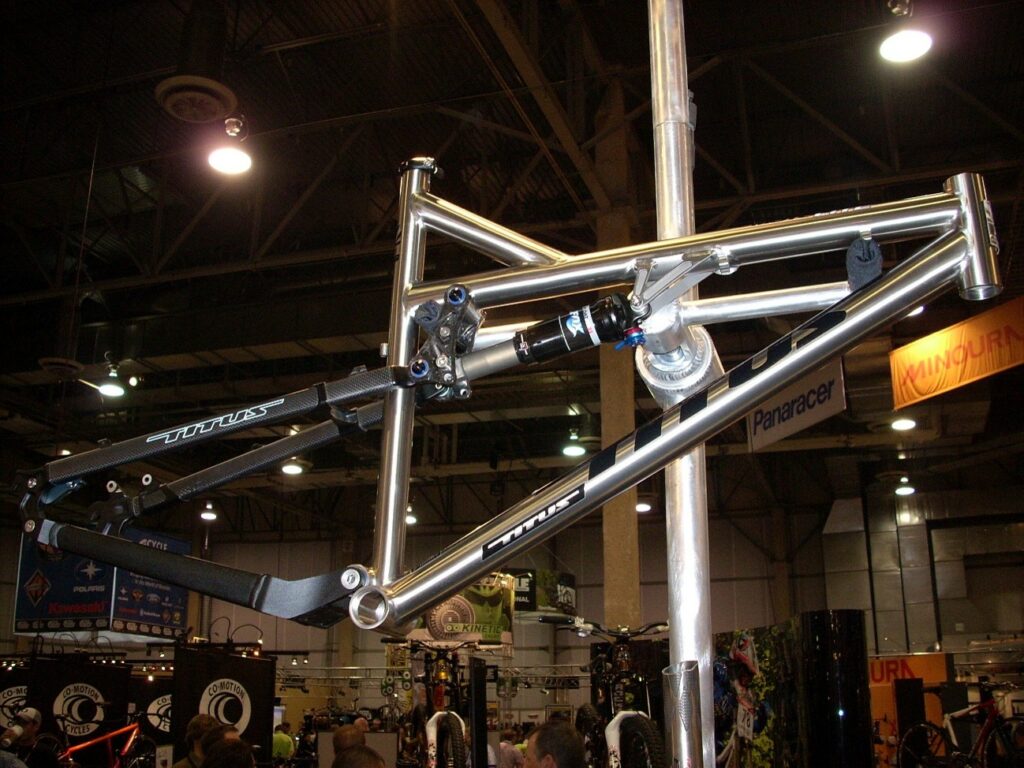
Titus titanium bike frame with carbon fiber suspension. Credit: Keanu @ no:wp
This kind of hybrid approach makes a lot of sense from an engineering standpoint—take advantage of the strengths of both materials.
One of the industries that does this a lot is high-end sports equipment. You’ll find bikes that combine titanium and carbon fiber like the one above, as well as components like chainrings and rims. It’s also common in premium golf clubs, where each material is used strategically to fine-tune performance.
TL:DR
Carbon fiber is lighter and stiffer. In general is better for weight-critical applications.
Titanium is tougher, better for impact-resistance, and way better at handling heat.
If you need ultralight performance, go carbon fiber.
If you need durability or high-temp resistance, go titanium.
Best of both worlds? Combine them strategically