

Natural fibre composites are no longer confined to low-load or purely aesthetic applications. Over the past decade, flax reinforcements in particular have matured into engineerable materials that combine low density, attractive specific stiffness and outstanding vibration damping, while meeting increasingly demanding industrial requirements.
At Managing Composites (MC), our interest in flax is not driven by trends, but by the convergence of functional performance, industrial scalability and credible sustainability. In this context, Biofibix stands out for its deliberate focus on engineering consistency into flax reinforcements, rather than treating variability as an inherent limitation.
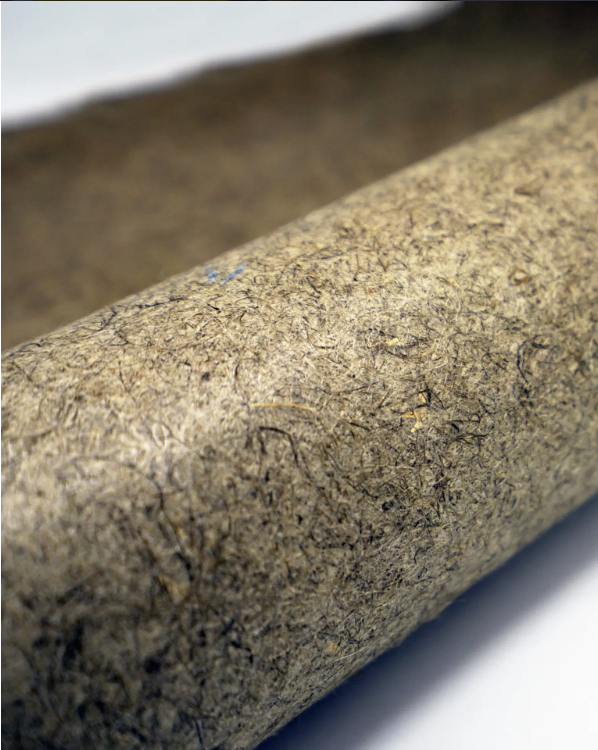
Flx Fiber Hypermat. Photo credit: Biofibix
Why flax is back on the engineering agenda
Flax fibre composites offer a combination of properties that is difficult to replicate with synthetic reinforcements alone:
Low density, enabling lightweight structures with competitive specific stiffness
Exceptional vibration and sound damping, typically 2–3× higher than glass or carbon fibre composites
Functional transparency (e.g. radiowave transparency) and favourable impact behaviour
A sustainability profile backed by European traceability, industrial scale and science-based data
Extensive literature reviewed by the Alliance for European Flax‑Linen & Hemp shows that flax and hemp composites outperform most conventional materials in damping performance, making them particularly attractive for mobility, sports, rail, marine and comfort‑critical structures.
From fibre testing to composite-relevant properties
One common source of confusion in the past has been the way flax fibre properties are reported. Scatter observed in single-fibre tensile tests is often misinterpreted as poor material consistency. However, research led by KU Leuven and validated through inter-laboratory round‑robin testing demonstrates that impregnated fibre bundle testing (IFBT) provides a far more relevant and reproducible assessment of flax fibres as they actually behave in composites.
Using IFBT, the back‑calculated flax fibre properties show:
- Young’s modulus E ≈ 55–70 GPa at low strain
- Tensile strength ≈ 600–800 MPa
- Very low inter‑laboratory scatter (≤5%) for stiffness
- This methodology, now recommended by the Alliance, aligns flax property reporting with established practices for carbon and glass fibres and removes much of the perceived uncertainty around material .
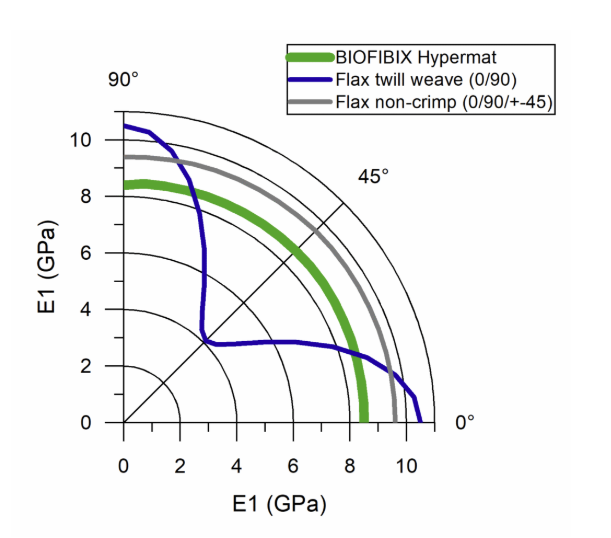
Hypermat modulus in different directions vs benchmark by Biofibix.
Moisture: a design parameter, not a blocker
Like all composite materials, flax composites are affected by environmental conditions. Moisture sensitivity is often highlighted as a weakness, yet Alliance guidelines make it clear that this does not prevent flax composites from being used in demanding indoor, outdoor or even marine applications.
Key takeaways from best‑practice guidelines include:
- Moisture effects must be accounted for at design level, just as with glass or carbon composites
- Composite stiffness may reduce at high humidity, while strength is generally retained
- Increased moisture content can even improve damping and fatigue behaviour
- Proper fibre conditioning, resin selection and edge sealing are decisive
- Decades of successful applications: from bridges and rail components to marine structures, confirm that moisture is a manageable engineering parameter rather than a fundamental limitation.
Biofibix Hypermat: designing consistency into flax
Biofibix approaches flax from an engineer’s perspective, combining controlled fibre sourcing, proprietary fibre treatment and an engineered non‑woven architecture known as Hypermat.
Rather than focusing on fibre variability, Hypermat is designed to deliver:
- Reduced resin pick‑up, enabling higher fibre mass fractions without resin weight penalties
- Improved fibre–matrix interaction and moisture resistance
- In‑plane isotropic mechanical behaviour, reducing dependency on complexstacking sequences
Hypermat is available in multiple areal weights and is compatible with mainstream composite processes such as vacuum infusion and light RTM. Published datasheets combine fabric descriptors with laminate-level mechanical data, supporting engineering evaluation rather than marketing claims.
Moving beyond coupons: demonstrator-driven validation
To validate real‑world behaviour, Biofibix and MC deliberately focus on geometry‑driven demonstrators, not just flat coupons.
A notable example is the hypercar rear wing demonstrator produced by resin infusion using Hypermat combined with local glass reinforcements. The component demonstrates:
- Manufacturability in stiffness‑critical geometries
- Multidirectional mechanical response without complex ply books
- Fibre mass fractions reaching ~45%
- Traceability from flax field to finished part
Such demonstrators help translate laboratory‑level data into production‑relevant insights. A necessary step for industrial adoption.
Where Hypermat fits and where it doesn’t
Flax composites will not replace carbon fibre in ultra‑high stiffness applications. Their value proposition lies elsewhere:
- Good specific stiffness combined with superior damping
- Process robustness and resin economy
- Reduced mass and CO₂ footprint
- Distinctive aesthetics and tactile quality
For engineers, the real differentiator is not a single strength or modulus value, but the ability to design predictable, repeatable parts at scale. Hypermat addresses this by shifting the discussion from fibre variability to controllable reinforcement architecture.
MC perspective
At Managing Composites, we see Biofibix as part of a broader shift in natural fibre composites: away from exploratory use and towards engineering-grade materials supported by standards, guidelines and demonstrator data.
Flax is no longer an experimental alternative. With the right testing methodology, process discipline and reinforcement design, it is becoming a reliable option for semi‑structural and functional composite parts — and Biofibix Hypermat is a clear illustration of that transition.
Further reading: Alliance publications on vibration damping and moisture management provide open, science‑based references for engineers evaluating flax composites.
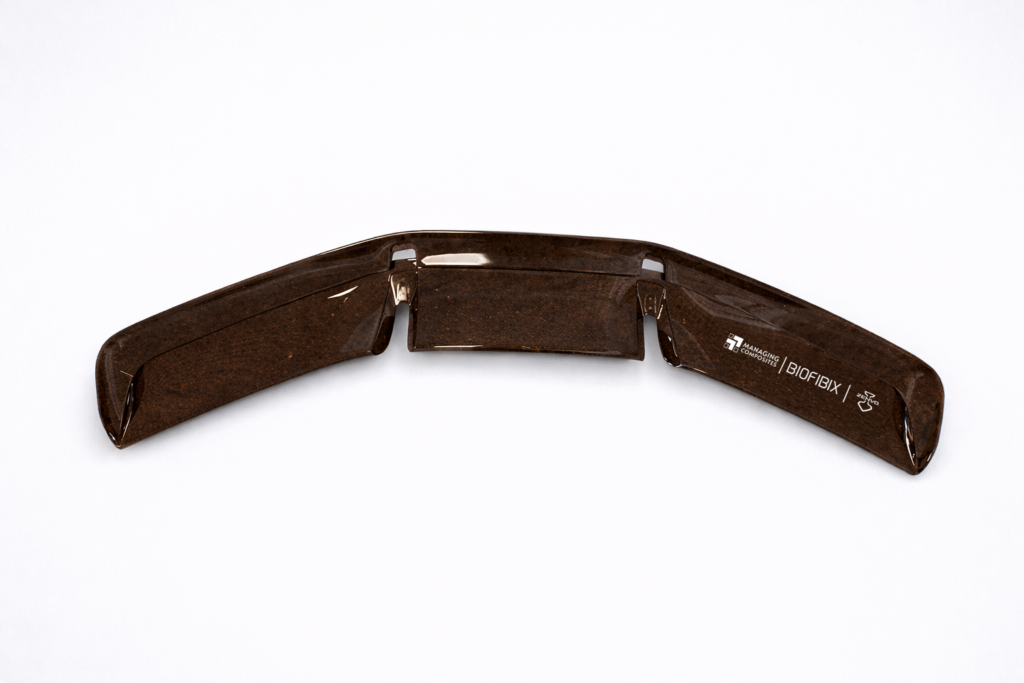
Hypercar rear wing prototype made by Managing Composites, Biofibix & Zenvo.